Sunday, January 16, 2022

Epiphany 2 C - January 16, 2022

Holy Cross Monastery, West Park, NY

Br. Josép Martinez-Cubero, OHC

Epiphany 2 C - Sunday, January 16, 2022


“They have no wine.” “Woman, what concern is that to you and to me? My hour has not yet come.” Ay, no no, Jesus. That is not a response I would ever give my mother. Her response would likely be: “Nene, I don’t care about you hour. They have no wine!”

Today’s Gospel lesson is not really a story about scarcity, but a story about abundance- lavish, even excessive; about 150 gallons of first-rate wine just to keep the party going where, from our reading, we gather many are already drunk! So, I must acknowledge from the start, having a bit of struggle reconciling a biblical story about such extravagance with our current global reality of such severe scarcity in so many places. “They have no wine.” 

Mary’s presence in this story, however, is what has been speaking most to me as I’ve prayed with this story for the past few days. She appears only twice in John’s Gospel: in this passage about the wedding at Cana, and later on when she stands at the foot of the cross. These two brief appearances by Mary connect Jesus' first sign and his last breath. But through her pivotal role in this story, I can hold up the promise of God’s abundance against scarcity and need.

“They have no wine,” she says to Jesus. I get it. It’s a line that has daily incarnations in my prayer life: “They have no clean water.” “They have no food.” “He has no money.” “She has no cure.” “They have no justice.” “I have no more patience.” It is the line a pray when I feel helpless and don’t know what to do. It’s the line I pray when I feel like all I have left in me is to insist on the power of telling God the truth as I see it in my daily prayer. “They have no wine.” 

This is the thing; I know this Gospel lesson about Jesus turning water into wine reveals God’s generous nature, and the miracle constitutes the first of seven “signs” of Jesus’ divinity, and the event is the onset of the Incarnate Word’s public ministry. It is a beautiful “epiphany” story full of symbolism and eschatological significance and blah blah blah! But at the end of the day, I have no idea how to turn gallons of water into gallons of wine (not that I think that is actually possible!) But I do know how to do what Mary does. I am thankful that God has given me a well-trained tongue and the ability to speak up and say: “Something’s up.” “Things are not okay.” “There is a need here.” "They have no wine." So to me, Mary is the hero in this Gospel story, and I will tell you why.

In the ancient world, wedding feasts lasted for days, the host was expected to provide abundant food and drink for the duration of the festivities. To run out of wine early was a dishonor and a disgrace. Scholars have many opinions and interpretations about what Mary’s connection to the bride and groom may have been, but no one really knows. And to me, the point is that she is one guest among many, and even amid celebration and distraction, she notices need. She perceives the likelihood of embarrassment and humiliation before Jesus does. “They have no wine.”

Mary notices need, and then, she tells the right person. I’m sure must of you know that stupid song, “Mary did you know?” Well, she does know! She knows who her son is, and she is confident of his ability and his generosity to meet the need.
  
Mary notices need, she tells the right person, and then, she persists. I don’t get Jesus’ initial reluctance to help when Mary first approaches him. Perhaps he is not too eagered to begin the countdown to the crucifixion. But whatever the case may be, Mary isn’t faced by her son’s reluctance. There is a problem, right here, right now, and she insists on a change of plans.

Mary notices need, she tells the right person, she persists, and then, she trusts. She doesn’t set out any expectations. She doesn’t tell Jesus what to do. She offers no suggestions about what kind of wine they need. Mary trusts her son’s loving, generous character, even when he initially shows reluctance.

Mary notices need, she tells the right person, she persists, she trusts, and then, she invites obedience: “Do whatever he tells you,” she says to the servants. There was no running water in the ancient world, and stone jars that could hold 20 to 30 gallons of water must have been huge and heavy! Thinking about how difficult the servants’ task must have been, reminds us of the committed obedience that alone makes faith possible.

So, in this Gospel story, Mary acts as a catalyst, holding open the door for something to happen, the door to a new possibility, the door to a new life, the door of hope. She serves as a great example for all of us- to notice need, to tell the right person, to persist, to trust. And sometimes we need to be the ones who obediently carry the stone jars and pour water even when we can’t even imagine that it will make a difference. And sometimes we need to be the chief steward recognizing new wine and encouraging others to taste new life.

"They have no wine."  “Do whatever he tells you.”  May we live in the tension between these two lines, that illumined by God’s Word and Sacraments, may shine with the radiance of Christ's glory. We can keep human need before our eyes, and tell God hard truths, even as we celebrate the abundance of God’s love. ¡Que así sea, en el nombre del Padre, del Hijo y del Espíritu Santo!

Amen+

Sunday, January 2, 2022

Second Sunday of Christmas - January 2, 2022

Holy Cross Monastery, West Park, NY

Br. Robert James Magliula, OHC

Christmastide 2 - Sunday, January 2, 2022


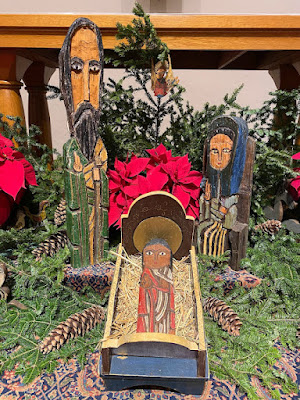
The Holy Family from a creche
by Jonathan Kendall (1939-2004)

Matthew’s infancy narrative is set in the turbulence and terror of a violent history where tyrants kill children and families become refugees who flee in the middle of the night. There are no shepherds or choirs of angels but only a provident God who guides and empowers a devout, compassionate, and trusting Joseph in the most uncertain of times. Matthew is writing to a predominately Jewish audience using the Hebrew Scriptures to emphasize the prophetic fulfillment of God’s purpose. He’s less concerned about how things happened than by what they mean. In a dream, evoking the Exodus experience, an angel directs Joseph to take his family and flee to safety in Egypt. Joseph moves from promise to terror with the dreaming of one dream. The nightmare doesn’t end when Joseph wakes. The following dreams continue the oscillating pattern between hope and nightmare. 
The intense compression of Matthew’s story reveals the truth of the human situation. It shows us to be capable of passionate desire to search, find, and adore God and our massive intransigence to grace, not only in the human heart, but also in our systems of military and political power that repress with brutal violence our highest and holiest yearnings. Setting up our nativity this year, I found myself wondering if Jonathan Kendall, the artist who created our nativity, was a dreamer recognizing another dreamer, as he carved and painted the figure of Joseph. Joseph has been a focal point for me this season. Given Jonathan Kendall’s life, I found myself pondering how he expressed in wood what Matthew expressed in word.
 
Jonathan Kendall and his partner, Charles McLeod, were artists-in-residence here in the 70’s. These itinerant artists led a rather nomadic and chaotic life on the edge of society. His carving of Joseph looms large, literally, in stature and presence, over all the figures, including Mary and the Kings. I found myself wondering if his expression of Joseph’s stability and strength suggested his recognition of his own vulnerability and need for a protector. This Joseph calls all who observe Jesus’ birth to renew their hope in God’s care. Joseph dared to see things as they were and still affirmed that God was working, even within humanity at its worst. Nothing would defeat God’s promise in Emmanuel, God with us.
Joseph would have been very familiar with Jeremiah’s life and prophesy. Perhaps, it was the word God gave Jeremiah that aroused hope in Joseph. Across the centuries, Jeremiah, also in uncertain times, echoes the presence and tenderness of God amid trouble. 

“With consolations I will lead them back.” These words were spoken at a time when there was little evidence that anything remotely resembling what he hoped for would come true. Thousands of his people were already in captivity in Babylon. He was in a precarious position himself in Jerusalem because his warnings to the rulers had labeled him as an enemy of his own people. He expressed anger, weariness, fear, and frustration, yet he never gave way to a bitterness or cynicism that could have so easily been justified. Devastated by the rejection and contempt he received; he clung to hope. He summoned up the inner strength to speak of a future joy as if it were already being experienced. His fortitude, like Joseph’s, arose from their understanding of the nature of God. God was faithful. Even dangers and disasters were understood to be within the rule of God. God is all in all, not merely the God of the nice and easy parts of life. 

God demonstrates providential care especially in uncertain times, times like ours. In many ways we face what Jeremiah and Joseph faced---social turmoil, great changes, strident voices, deep divisions of thought and attitude, concern for the future----generating anger, confusion, fear, and frustration. It’s in times of crisis that meaning is challenged, decisions questioned, and doubts unearthed. It’s alarming and exhausting. It can drain hope and joy out of the present moment. In such moments, our own understanding of God is supremely important. Our vision of God shapes our character and attitudes. We will engage life according to who and what we understand God to be. God’s presence and tenderness are obvious in Jeremiah when he speaks of his people’s return home together. This is a people who have discovered compassion in their exile experience. Even in the struggle of their return, they tend those among them who are needy and vulnerable. They, like Jeremiah and Joseph, have found grace in their exile. We too are a people who are being called to discover grace and compassion in our times.

Even when our private little worlds go to dust, hope digs in the ruins of our heart for memory of God’s promise to bring good out of bad, life out of death. Hope is not just a vague feeling that things will work out when it’s evident that things will not just work out. It’s not optimism in the face of dire circumstances, nor is it founded on denial. Rather, hope is the conviction, that God is tenacious and persistent in overcoming the risks and deadliness of the world, that God intends joy and peace. Hope offers us an experience of trust that God’s presence, love, and mercy is in and all around us, regardless of circumstances or future outcome. Hope keeps life open to grace and to a future created by God rather than ourselves. Joseph and Jeremiah believed that a provident and faithful God was present in their trouble. 

When we demand any completion to history on our terms, when we demand that our anxiety or dissatisfaction be taken away, we are refusing to hold out for the full picture that is always still being given by God. Hope is the patient and trustful willingness to live without full closure, without resolution, and still be content because our satisfaction is now at another level, and its source is beyond ourselves. I still find myself musing over whether Jonathan Kendall lived with that vision as he moved from place to place, leaving a trail of art behind him which kept expressing it. 

What Christ did on earth was to undergo stage by stage, the whole experience of being human, to bring the human together with the Divine in a restored relationship. Notice that Kendall has Joseph standing guard over an infant that is not passively slumbering, but one with eyes wide open, alert, present, hand raised in blessing along with Joseph’s and Mary’s, for us today on our journey home. The author of Ephesians gives assurance of God’s goodness and faithful plan for us, and the resolve to reorder us and the cosmos with righteousness and peace through the rule of this wide-awake Child. 

Oscar Romero once said that it is only the poor and hungry, those who know they need someone to come on their behalf, who can celebrate Christmas. It is precisely because we are weary, and poor in spirit, that God can touch an artist and us with hope. This is not an easy truth. It means that we do not gloss over the evils we confront every day, both within ourselves and without. Jesus, with great persistence and great vulnerability, turned the enmity of society toward a new possibility, turned the sadness of the world toward joy, and introduced a new regime where the dead are raised, the lost are found, and the displaced are brought home again. +Amen

Saturday, January 1, 2022

Feast of the Holy Name - January 1, 2022

Holy Cross Monastery, West Park, NY

Br. Aidan Owen, OHC

Feast of the Holy Name - Saturday, January 1, 2022


In the name of the One God, who is Lover, Beloved, and Love Overflowing. Amen. 

A few years ago, a friend invited me to join a Sufi prayer service in New York. The service—called zhikr, which means “remembrance”—consists in large part in chanting the divine names. After the traditional salat prayers, made in the direction Mecca, about thirty of us gathered in a circle. Facing one another, the sheikha began by intoning, very gently, la illaha illa’ llah. There is no God but God. Or, put more literally and mystically, there is nothing but God. We repeated the phrase back to her, la illaha illa’ llah and began to move our heads and then our bodies very slowly to the left and then back to center. Gradually the chant picked up in volume and pace. It got loud and declarative—there is nothing but God—then soft and sweet again: there is nothing but God. This movement back and forth, up and down, must have gone on for ten minutes or so, before flowing into another of the divine names, and still another, and still another, until it seemed we were all caught up together into the heart of God. 

 I have never, at any other time, experienced anything like that evening of prayer. It was timeless. For the space of our chanting, swaying, and eventually dancing, we were all joined to one another and to God, and time ceased to flow around us. It was both a remembering of our essential unity with God and one another, and a time of forgetting anything but our bodies, our breath, and the humming connection between the particles of our being. 

Pir Ziya Inayat-Khan, the head of the Inayat Sufi order, explains zhikr this way:  

“The essential practice in Sufism is ‘zikr,’ which means remembrance—remembrance of God, remembrance of the source and goal of all being, remembrance of our true home… Flowing endlessly from this One the Sufi discovers a force, an emotion, which will not fit into the narrow boxes of human language. The closest we can come to naming it is to speak of ‘love.’ There is no higher calling than to make one’s life a pure channel for this primal force, the compassion and yearning that has given rise to all that is. Sufism is the path of purification and remembrance by which the heart is made its vessel.”1 

Although the tradition is much quieter and smaller in Christianity than in Islam, we, too, have practices of praying the divine name. Best known is certainly the Jesus Prayer, which, in its fullest version goes like this: Lord Jesus Christ, Son of the Living God, have mercy on me, a sinner. This prayer is not mere confession. Nor is it only or primarily an act of contrition or a call for forgiveness. Its goal is not to comfort, but to unite the soul with God. Those who have prayed the Jesus prayer for decades attest that it eventually settles so deeply into the heart, that the heart calls out its love to Jesus every moment of every day. This ancient prayer is said to draw the person back to God, to knit the two together, so that, as in zhikr, we remember that we have never been nor ever will be separate from the One we name. 

The Sufis say that the name Allah is the name that contains all names. We could say the same of the name Jesus. While Paul reminds us that Jesus is the Name that is above every name we should not hear the word “above” in a hierarchical sense. No, Jesus is the name by which we call the Word of God, God’s very substance, in all its creative and mysterious depth, the Word made Flesh, the vast infinitude and mystery of the Godhead, made accessible to our love and our longing. Jesus is the face of God turned toward humankind, indeed toward all creation, to draw us ever deeper into the heart of God.  

I used to really dislike what we call the Prayer of Humble Access, a now old-fashioned devotional prayer used at the time of Communion. But, as my brothers can tell you, my opinions are more strongly expressed than strongly held most of the time. I have come to find great depth and love buried in the words of that prayer, which I’ve modified and condensed to suit my own relationship with God. As I pray it, it goes like this: “O Lord, I am not worthy that you should come under the roof of my house, but only speak your Word in me, and my soul shall be healed.”  

One day recently, the Lord caught me by surprise. The Spirit jumbled up the words I was whispering in heart, and I found the prayer emerging of its own will almost: “O Lord, I am not worthy that you should come under the roof of my house, but only speak my name in you, and your soul shall be healed.” I was asking God to speak my name in God’s soul, and praying for God’s soul to be healed. Tears welled up before I could feel ashamed and abashed at my impertinence, and I was able to rest in the gift and the truth of that prayer.

As much as our prayer is an approach to God, it is much more God’s approach to us. As Paul reminds us, we do not know how to pray as we ought, but the Spirit intercedes within us, with sighs too deep for words. Sighs that often sound like the name Jesus. As we pray the name of God, as we repeat our feeble Jesus over and over again, giving voice to our longing for God, just so God is chanting our name in her heart, crying out in longing and in love for each of us, drawing us nearer and nearer in her desire to be—in Julian’s wonderful phrase—“one-ed” to us again. 

In the beginning was the Word, and the Word was with God, and the Word was God. You might say, in the beginning there was nothing but God—la illaha illa’ llah. Then God, “the prodigal who squanders himself” (in Karl Rhaner’s brilliant phrase) spoke the Word—the name Jesus—shattering the silence. Our own names, our very being, the flesh of our bodies and the ground beneath our feet, is the echo of that name reverberating throughout time and space. As we center ourselves in the name that is above and below and within every other name—Jesus—we can begin to remember once again that there is not now, nor has there ever been anything but God. God with us, God within us, God around us. Nothing but God.