Holy Cross Monastery, West Park, NY
Br. Josép Martinez-Cubero, OHC
The First Sunday after Christmas Day - December 29, 2019
Isaiah 61:10-62:3
Galatians 3:23-25; 4:4-7
John 1:1-18
Click here for an audio version of this sermon.
Today's gospel lesson is John's nativity story; it is not with shepherds and angels or a babe wrapped in swaddling clothes lying in a manger. In this nativity story, John echoes the words from the book of Genesis: In the beginning when God created… God said, "Let there be light." In John's gospel, from the very beginning was the Word. This notion is a very important event in the evolution of how the early Christians thought of Jesus as the glorified Christ, the Son of God.
Paul, the earliest of New Testament writers, in his earlier writings, speaks of Jesus as becoming the Son of God in his resurrection. For Mark, writing about twenty years after Paul, Jesus is revealed as the Son of God at his baptism. Matthew and Luke, writing about ten to fifteen years after Mark, describe Jesus as the Son of God at his birth. Just after Matthew and Luke, Paul’s thinking about Christ has evolved and writing to the Colossians, speaks of Christ as the "first-born of all creation." But in the fourth gospel Christ is not born at all. The Word was always with God even before creation began.
John’s Prologue is one of the most beautiful scripture passages. It’s poetic form, however, can sound somewhat cryptic. And, so, my preparation for this sermon led me to the original Greek language of the text and to checking the accuracy of the translation. It is one of my favorite exercises when studying scripture, thanks to our Brother Roy, who, when I was a novice, would always come to our Bible Studies with his Greek New Testament and Greek Lexicon.
"In the beginning was the Word." The Greek word is Logos and varies in meaning depending on what period in history it is being used. By the time of John’s writing, logos had come to mean the creative power of God and the kingship of God over all things. Philo, a first century philosopher, saw logos as flowing from God, and as the mechanism through which God created the universe. Logos combines the concepts of thought, deed, and power. For the author of the fourth gospel, logos is an expression of God's innermost nature which is present in the world.
John’s threefold claim, “in the beginning was the Word, and the Word was with God, and the Word was God” reveals the origin of Jesus, his relationship with God, and his identity as God. These truths about Jesus are essential to John’s portrait of Jesus, the meaning of the incarnation, and also signify that which describes our own humanity. We make sense of our humanity through these categories of origin, relationship, and identity, and now God has chosen to live these truths.
The God who spoke and said, "let there be light," became flesh and lived among us. The Greek phrase translated as “lived among us” has really to do with indwelling. That is a significant difference. For John, the Word became flesh and indwells us. It was not a temporary event that happened in the first century. If we recognize it, the Word indwells us today, and every day.
John says, "What has come into being in him was life, and the life was the light of all people.” The light and life is intended for all people. The author has chosen words and symbols that not only the Jewish community can understand, but with which the Greek community would also resonate. Jews would be reminded of the Creation of world in Genesis and the Wisdom of God active in Creation in Proverbs. Greeks would understand the creative principle of order in the universe understood as the Logos. The Word made flesh is a gift intended for everyone, not just for some.
“The light shines in the darkness, and the darkness did not overcome it." Darkness in the gospel of John is depicted as light's adversary. Since light manifests the power and presence of God, the darkness refers to the powers that oppose God: sin and evil. In John's Gospel, sin is human rebellion against God. Sin and evil are formidable foes to be sure, but ultimately cannot overcome the light of God's Word. Light, you see, can warm the bones, yes, but can also burn like a laser. Light shines into our relationships and communities when we welcome it into our lives to heal, yes, but also to expose; to warm, yes, but also to burn away evil.
“[T]o all who received him, who believed in his name, he gave power to become children of God". The word translated as “believe,” really means "radical trust," an orientation of one's entire self, and not just the intellect as the word "believe" would imply. The status of "children of God" has completely to do with trust, and is certainly "not of blood." The Greek word is actually a Hebrew idiom for "bloodshed" or violence. Children of God do not attain their status through violence or war. Nor are children of God born out of "the will of the flesh," in other words, through the established ways of the world- superficial satisfaction, and greed. Nor are children of God formed "out of the will of man." In a gospel that, amazingly, repeatedly uses the inclusive word anthropos to refer to human beings in general, here, the author uses a word that specifically relates to men, andros. I can’t help but to conclude that the gospel makes it clear that children of God are not formed by male headship but by God alone.
The incarnation shows us a different way of seeing life and living in the world. We are called to let the light of the incarnate Word, enkindled in our hearts, shine forth in our lives. We are called to be blessings. We are called to follow the way of Love. We are called to be fully alive. We are called to be holy, not as an achievement on our own but as a gift of God. Through faith we have been given the power to become children of God.
A Jewish friend once told me that she knew a rabbi who told a story about each person having a procession of angels going before them and crying out, “Make way for the image of God.” Can you imagine living with this as our reality and the truth that guides our lives? The implications are profound. It changes how we see one another and ourselves. Perhaps that is the truth for this first Sunday after Christmas Day for us. And the Word became flesh and indwells us. Are you recognizing the Word become flesh in your own life and in the lives of others? Do you see the procession of angels and hear their voices? And the Word became flesh and indwells us today, this very present moment. So make way for the image of God, and may the light of the incarnate Word, enkindled in our hearts, shine forth in our lives. ¡Que así sea en el nombre del Padre, del Hijo y del Espíritu Santo! ~Amen+
Sunday, December 29, 2019
Wednesday, December 25, 2019
Christmas Day - Wednesday, December 25, 2019
Holy Cross Monastery, West Park, NY
Br. Robert Sevensky, OHC
Christmas Day - Wednesday, December 25, 2019
Isaiah 9:2-7
Titus 2:11-14
Luke 2:1-14(15-20)
Click here for an audio version of this sermon.
The year 2017 saw the passing, at far too young an age, of a wonderful novelist, essayist, poet and story teller, Brian Doyle. Doyle was never a major public literary figure, but he had a following. He was known as a “Catholic writer,” but that title fits him fully only if we understand catholic in its broadest and most primitive sense of universal, for his topics covered the spectrum of human relations, the natural world, humor with an Irish tinge, and yes, religion.
I want to share with you part of an essay he wrote some years ago:
Doyle told no one of his experience for more than a year, until finally he shared it with two friends who had themselves been, as he puts it, “Spoken to in moments of great darkness.”
I've been Spoken to as well, four times as I reckon it, though only once were there actual words involved. And that experience was much more dramatic than even Doyle's, involving as it did a crucifix with its head turning and speaking...a little like something out of The Exorcist. But the words—all seven of them—were words of gentle invitation. I won't share them with you, but I can tell you that I was totally surprised by my response. “Yes” I said. “Of course.” Where did that come from? And like Doyle, I've pondered those seven words for now over twenty years.
I want to propose two suggestions this Christmas Day.
The first is that many people—billions perhaps—have been Spoken to. But many of us have forgotten the words or suppressed them or shared them with no one else, lest we be considered odd or weird or crazy. Or even worse, religious fanatics. But dear people, it happens all the time. The Mother speaks words of wisdom. The crucifix moves. The sun dances. The bird on the wing exalts the soul. The cry of a baby opens up worlds unseen and unknown.
The 16th century German radical reformer Thomas Muntzer once said: “I will not pray to a mute god.” And neither should we. But, in point of fact, God is not mute. God speaks and continues to speak through the ages and nations and cultures and religions of the world and through the astonishing and now endangered structures of this created order. And to and through people just like you and me.
Where have you been Spoken to? Where has the Holy One—blessed be He—where has the Holy One touched your heart? Because you know He has. And He will touch it again. Are you being Spoken to, addressed, summoned, called today, perhaps right now? People, we must listen up. We must pay attention.
The second thing I want to suggest—no, more than simply suggest, but rather proclaim—is that God has spoken powerfully and in a most unique and astounding way in and through Jesus Christ, whose coming among us we celebrate today. And this not simply through Jesus the great moral teacher, or the spiritual guide, or healer and prophet or social critic. And not just through the Jesus of the Cross and Passion and Resurrection. Not even through that Jesus whose power to transform our dying world into something new and revolutionary is already happening. Though to be sure, all that is real Speaking, living and life-giving. But God speaks perhaps most powerfully through the simple and mind-boggling affirmation that in a child, in this Christmas Child, God draws us toward Love and to love.
Hear what Austin Farrer, the great Anglican theologian of the last century, has to say:
God speaks to us through this Child, mewing for milk and not even knowing it. And in this Child's neediness, vulnerability and profound lowliness, the eternal God stoops to become one of us, one with us, dwelling among us, drawing love out of us. And at the same time transforming us and all creation. We are raised—all of us—to divine life. And we take with us everything: animals, plants, waters, earth itself. For this is, as St. Basil says, a festival of all creation. “And heaven and nature sing!”
Individual messages can be powerful and transformational. I am grateful for those times when the veil has been pulled aside for a moment, and I was graced with a glimpse of eternity. But in his humble, indeed mute, Speaking, this Child in a manager says more. And we have yet, after two thousand years, to wrap our minds and our hearts around it.
But there is, I believe, Good News, and that is that we needn't worry too much. In the fullness of time for you and me, sooner or later, the Mother will come speaking words of wisdom. The crucifix will turn its head. The sun will rise. The bird will soar. The partner or friend will laugh. A stranger will startle us with an unexpected act of kindness. A baby's cry will split the night. And suddenly, suddenly, new worlds will open before us.
Because Christmas is always happening. Always.
And as I might say once again: “Yes, of course.”
Merry Christmas.
Br. Robert Sevensky, OHC
Christmas Day - Wednesday, December 25, 2019
Isaiah 9:2-7
Titus 2:11-14
Luke 2:1-14(15-20)
Click here for an audio version of this sermon.
The year 2017 saw the passing, at far too young an age, of a wonderful novelist, essayist, poet and story teller, Brian Doyle. Doyle was never a major public literary figure, but he had a following. He was known as a “Catholic writer,” but that title fits him fully only if we understand catholic in its broadest and most primitive sense of universal, for his topics covered the spectrum of human relations, the natural world, humor with an Irish tinge, and yes, religion.
I want to share with you part of an essay he wrote some years ago:
I’ll tell you a story. Some years ago I sat at the end of my bed at three in the morning, in tears, furious, frightened, exhausted, as drained and hopeless as I have ever been in this bruised and blessed world, at the very end of the end of my rope, and She spoke to me. I know it was Her. I have no words with which to tell you how sure I am that it was the Mother. Trust me.
Let it go, She said.
The words were clear, unambiguous, crisp, unadorned. They appeared whole and gentle and adamant in my mind, more clearly than if they had somehow been spoken in the dark salt of the room. I have never had words delivered to me so clearly and powerfully and yet so gently and patiently, never.
Let it go.
I did all the things you would do in that situation. I sat bolt upright. I looked around me. I listened for more words. I looked out the window to see if someone was standing in the garden talking to me through the window. I wondered for a second if my wife or children had spoken in their sleep. I waited for Her to say something more. She didn’t speak again. The words hung sizzling in my mind for a long time and then faded. It’s hard to explain. It’s like they were lit and then the power slowly ebbed.
Let it go.
She knew how close I was to absolute utter despair, to a sort of madness, to a country in which many sweet and holy things would be broken, and She reached for me and cupped me in Her hand and spoke into the me of me and I will never forget Her voice until the day I die. I think about it every day. I hold those words close and turn them over and over and look at them in every light and from every angle.
Doyle told no one of his experience for more than a year, until finally he shared it with two friends who had themselves been, as he puts it, “Spoken to in moments of great darkness.”
I've been Spoken to as well, four times as I reckon it, though only once were there actual words involved. And that experience was much more dramatic than even Doyle's, involving as it did a crucifix with its head turning and speaking...a little like something out of The Exorcist. But the words—all seven of them—were words of gentle invitation. I won't share them with you, but I can tell you that I was totally surprised by my response. “Yes” I said. “Of course.” Where did that come from? And like Doyle, I've pondered those seven words for now over twenty years.
I want to propose two suggestions this Christmas Day.
The first is that many people—billions perhaps—have been Spoken to. But many of us have forgotten the words or suppressed them or shared them with no one else, lest we be considered odd or weird or crazy. Or even worse, religious fanatics. But dear people, it happens all the time. The Mother speaks words of wisdom. The crucifix moves. The sun dances. The bird on the wing exalts the soul. The cry of a baby opens up worlds unseen and unknown.
The 16th century German radical reformer Thomas Muntzer once said: “I will not pray to a mute god.” And neither should we. But, in point of fact, God is not mute. God speaks and continues to speak through the ages and nations and cultures and religions of the world and through the astonishing and now endangered structures of this created order. And to and through people just like you and me.
Where have you been Spoken to? Where has the Holy One—blessed be He—where has the Holy One touched your heart? Because you know He has. And He will touch it again. Are you being Spoken to, addressed, summoned, called today, perhaps right now? People, we must listen up. We must pay attention.
The second thing I want to suggest—no, more than simply suggest, but rather proclaim—is that God has spoken powerfully and in a most unique and astounding way in and through Jesus Christ, whose coming among us we celebrate today. And this not simply through Jesus the great moral teacher, or the spiritual guide, or healer and prophet or social critic. And not just through the Jesus of the Cross and Passion and Resurrection. Not even through that Jesus whose power to transform our dying world into something new and revolutionary is already happening. Though to be sure, all that is real Speaking, living and life-giving. But God speaks perhaps most powerfully through the simple and mind-boggling affirmation that in a child, in this Christmas Child, God draws us toward Love and to love.
Hear what Austin Farrer, the great Anglican theologian of the last century, has to say:
Mary holds her finger out, and a divine hand closes on it. The maker of the world is born a begging child; he begs for milk and does not know that it is for milk that he begs. We will not lift our hands to pull the love of God down to us, but he lifts his hands to pull human compassion down upon his cradle. So the weakness of God proves stronger than men, and the folly of God proves wiser than men.
God speaks to us through this Child, mewing for milk and not even knowing it. And in this Child's neediness, vulnerability and profound lowliness, the eternal God stoops to become one of us, one with us, dwelling among us, drawing love out of us. And at the same time transforming us and all creation. We are raised—all of us—to divine life. And we take with us everything: animals, plants, waters, earth itself. For this is, as St. Basil says, a festival of all creation. “And heaven and nature sing!”
Individual messages can be powerful and transformational. I am grateful for those times when the veil has been pulled aside for a moment, and I was graced with a glimpse of eternity. But in his humble, indeed mute, Speaking, this Child in a manager says more. And we have yet, after two thousand years, to wrap our minds and our hearts around it.
But there is, I believe, Good News, and that is that we needn't worry too much. In the fullness of time for you and me, sooner or later, the Mother will come speaking words of wisdom. The crucifix will turn its head. The sun will rise. The bird will soar. The partner or friend will laugh. A stranger will startle us with an unexpected act of kindness. A baby's cry will split the night. And suddenly, suddenly, new worlds will open before us.
Because Christmas is always happening. Always.
And as I might say once again: “Yes, of course.”
Merry Christmas.
Sunday, December 22, 2019
The Fourth Sunday of Advent - December 22, 2019
Holy Cross Monastery, West Park, NY
Br. Robert James Magliula, OHC
The Fourth Sunday of Advent, Year A - Sunday, December 22, 2019
Isaiah 7:10-16
Romans 1:1-7
Matthew 1:18-25
Psalm 80:1-7, 16-18
Click here for an audio version of this sermon.
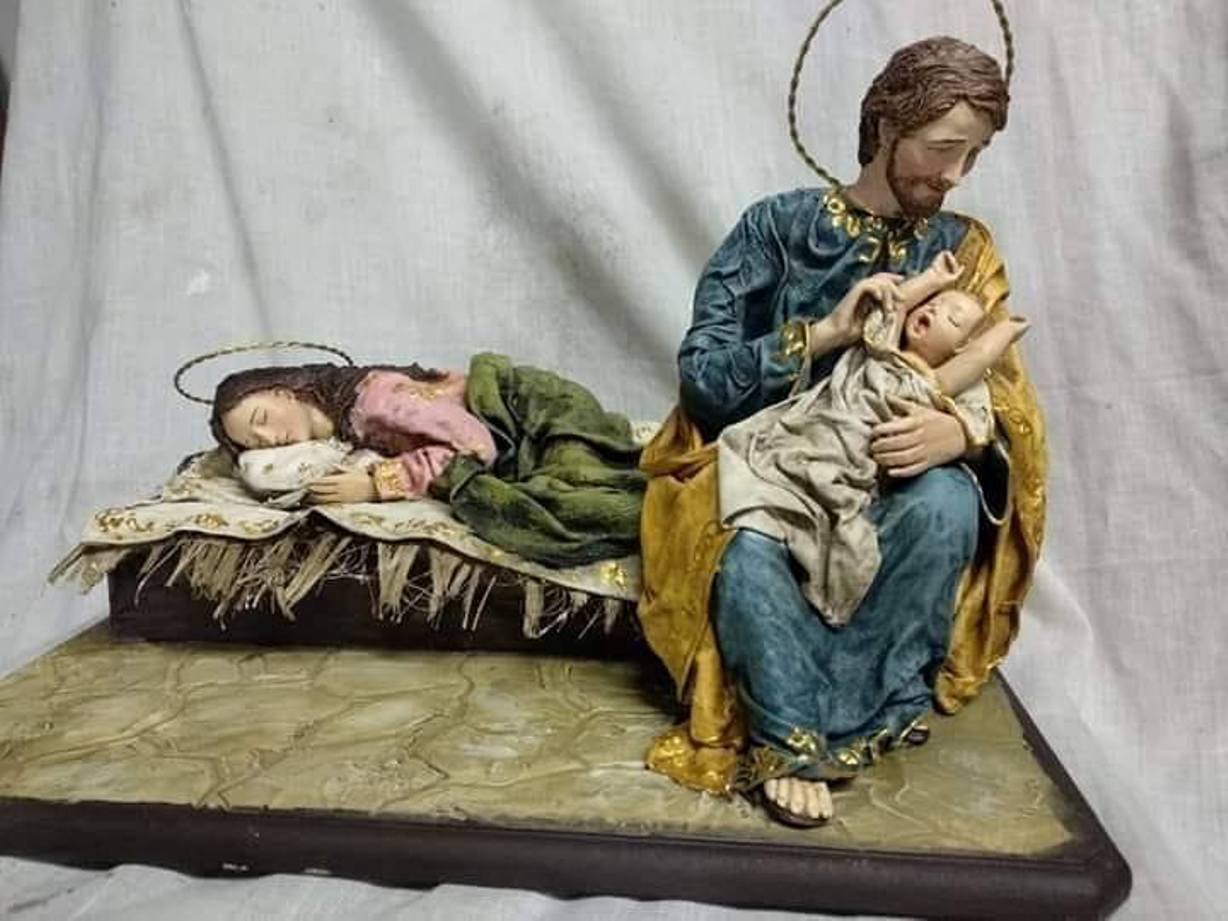
A few weeks ago, a friend posted a photo of a nativity scene picturing Mary sound asleep in the background and a young Joseph holding and delighting in the infant who was delighting in Joseph as well. Our Gospel today is about the annunciation to Joseph, not Mary. The image I described, and our Gospel challenge much of the legend that has grown up around Joseph. Christian tradition has never quite known what to make of him. He’s an extra in the drama which stars Mary and her child. He disappears from the gospels before Jesus is baptized and is never heard from again.
In Matthew’s Gospel, Joseph is the main character. Gabriel speaks to him, not Mary, as he lies sleeping. “Joseph, son of David, do not be afraid to take Mary as your wife, for the child conceived in her is from the Holy Spirit.” The salutation is important. If the Messiah is to be born the son of David, then this is the man he must be born to. The prophet said so, and Matthew goes to great lengths in his long genealogy of Jesus at the beginning of his Gospel, and later, quoting prophets throughout his Gospel, to persuade us that what the prophets foretold had come to pass. According to Matthew, the whole experiment hangs on what happens with Joseph, not Mary. If Joseph believes the angel, everything is on. The story can continue. Mary will have a home and her child will be born the son of David. But if Joseph does not believe, then everything grinds to a halt. Then Mary is an outcast for disgracing her family and herself. She will be disowned and left to survive however she is able, with her illegitimate child.
Matthew tells us that Joseph was a righteous man, and I would add, a loving, compassionate, and hopeful one as well. He was not naïve but courageous in his choices. He believed that Mary had been unfaithful. Betrothal was equivalent to marriage; infidelity counted as adultery. We have so sanitized this feast, that we forget just what a scandal the Incarnation really was. Today’s text reminds us that the preparations for that first Christmas were anything but conventional and far from proper. To Joseph, the pregnancy was a violation of social convention and ethics, as well as an emotional and physical betrayal.
Confronted with Mary’s presumed adultery, he decides on the most humane of his legal options, divorce, and to do it quietly so as not to endanger her. Despite whatever emotions were raging, he wasn’t willing to shame her or trash her reputation to clear his own. What emotional turmoil it must have been for him. It’s just such times that conjure basic questions. Outside our familiar framework, meaning is challenged, decisions questioned, doubts unearthed. It’s alarming and exhausting. It drains joy out of the present moment. At those times we reach back into all those behaviors or things that we have used to give at least the illusion of stability and safety. In reality, the most it gives is a brief respite from consciousness.
Joseph would have been very familiar with our first reading from Isaiah, where the prophet comes to reassure King Ahaz that all is not lost. God gives a sign: a young woman pregnant with a child of promise, a child born of a woman, with all the bloody and fleshly reality of full humanity. The child’s name, Immanuel, (“God is with us”) reinforces the divine promise of faithfulness and deliverance.
Perhaps it is the memory of this sign spoken by Isaiah that arouses hope in Joseph. Even when our private little worlds go to dust, hope digs in the ruins of our heart for memory of God’s promise to bring good out of bad, joy out of sadness, life out of death. Hope is not optimism in the face of dire circumstances, nor is it founded on denial. My experience is that hope is made of memories which remind me that there is nothing in life I have not faced that I did not, through grace, though unrecognized at the time, survive. Hope is the recalling of the good in the past on which we base our expectation of good in the future, however bad the present. Hope is not the conviction that something will turn out well, but the certainty that something will make sense, regardless of how it turns out.
Joseph was on the verge of divorcing, when an angel of the Lord started whispering hope in his ear. Joseph’s sense of right and wrong got lost in the divine shuffle. His righteousness gave way to God’s; his faithfulness a response to God’s. Even if he never fully grasped or understood what the angel told him, it ignited hope in him.
Faithfulness rarely feels good because it calls on us to set aside our emotions and preferences. It’s work, and it’s a prerequisite to trust and intimacy. Did Joseph like the situation that was thrust upon him? Was trust in Mary immediately restored? You can be sure that what transpired between these two human beings did not resolve overnight. It was a mess that only got messier before it got better. I have no doubt that it did get better. The proof is seen in Jesus himself who learned the love, compassion, and courage that was modeled by this man.
Joseph surveyed this mess he had absolutely nothing to do with and decided to believe that God was present in it. With every reason to disown it all, to walk away from it, Joseph claimed the scandal and gave it his name. He became the child’s father the moment he said so. The issue was not a biological but a legal one. He owned and legitimized the mess and it became the place where the Messiah was born. Joseph’s belief was as critical as Mary’s womb. It took the two of them to give birth to this child: Mary to give him life, and Joseph to give him a name.
Joseph, no less than Mary, is the one in the story who is most like us, presented day by day with circumstances beyond our control, with lives we may never have chosen for ourselves, tempted to divorce ourselves from it all, when an angel whispers hope in our ears: “Do not be afraid, God is here. It may not be the life you had planned, but God may be born here too, if you will own it.”
God’s birth requires human partners willing to love, to hope, willing to claim the mess, to adopt it and give it our names. And not just each one of us alone, but the whole Church, surveying a world that seems to have run amok and proclaiming over and over again to anyone who will hear that God is still with us, that God is still being born in the mess and through it, within and among those who will still hope and believe what angels tell them in their dreams. +Amen.
Br. Robert James Magliula, OHC
The Fourth Sunday of Advent, Year A - Sunday, December 22, 2019
Isaiah 7:10-16
Romans 1:1-7
Matthew 1:18-25
Psalm 80:1-7, 16-18
Click here for an audio version of this sermon.
A few weeks ago, a friend posted a photo of a nativity scene picturing Mary sound asleep in the background and a young Joseph holding and delighting in the infant who was delighting in Joseph as well. Our Gospel today is about the annunciation to Joseph, not Mary. The image I described, and our Gospel challenge much of the legend that has grown up around Joseph. Christian tradition has never quite known what to make of him. He’s an extra in the drama which stars Mary and her child. He disappears from the gospels before Jesus is baptized and is never heard from again.
In Matthew’s Gospel, Joseph is the main character. Gabriel speaks to him, not Mary, as he lies sleeping. “Joseph, son of David, do not be afraid to take Mary as your wife, for the child conceived in her is from the Holy Spirit.” The salutation is important. If the Messiah is to be born the son of David, then this is the man he must be born to. The prophet said so, and Matthew goes to great lengths in his long genealogy of Jesus at the beginning of his Gospel, and later, quoting prophets throughout his Gospel, to persuade us that what the prophets foretold had come to pass. According to Matthew, the whole experiment hangs on what happens with Joseph, not Mary. If Joseph believes the angel, everything is on. The story can continue. Mary will have a home and her child will be born the son of David. But if Joseph does not believe, then everything grinds to a halt. Then Mary is an outcast for disgracing her family and herself. She will be disowned and left to survive however she is able, with her illegitimate child.
Matthew tells us that Joseph was a righteous man, and I would add, a loving, compassionate, and hopeful one as well. He was not naïve but courageous in his choices. He believed that Mary had been unfaithful. Betrothal was equivalent to marriage; infidelity counted as adultery. We have so sanitized this feast, that we forget just what a scandal the Incarnation really was. Today’s text reminds us that the preparations for that first Christmas were anything but conventional and far from proper. To Joseph, the pregnancy was a violation of social convention and ethics, as well as an emotional and physical betrayal.
Confronted with Mary’s presumed adultery, he decides on the most humane of his legal options, divorce, and to do it quietly so as not to endanger her. Despite whatever emotions were raging, he wasn’t willing to shame her or trash her reputation to clear his own. What emotional turmoil it must have been for him. It’s just such times that conjure basic questions. Outside our familiar framework, meaning is challenged, decisions questioned, doubts unearthed. It’s alarming and exhausting. It drains joy out of the present moment. At those times we reach back into all those behaviors or things that we have used to give at least the illusion of stability and safety. In reality, the most it gives is a brief respite from consciousness.
Joseph would have been very familiar with our first reading from Isaiah, where the prophet comes to reassure King Ahaz that all is not lost. God gives a sign: a young woman pregnant with a child of promise, a child born of a woman, with all the bloody and fleshly reality of full humanity. The child’s name, Immanuel, (“God is with us”) reinforces the divine promise of faithfulness and deliverance.
Perhaps it is the memory of this sign spoken by Isaiah that arouses hope in Joseph. Even when our private little worlds go to dust, hope digs in the ruins of our heart for memory of God’s promise to bring good out of bad, joy out of sadness, life out of death. Hope is not optimism in the face of dire circumstances, nor is it founded on denial. My experience is that hope is made of memories which remind me that there is nothing in life I have not faced that I did not, through grace, though unrecognized at the time, survive. Hope is the recalling of the good in the past on which we base our expectation of good in the future, however bad the present. Hope is not the conviction that something will turn out well, but the certainty that something will make sense, regardless of how it turns out.
Joseph was on the verge of divorcing, when an angel of the Lord started whispering hope in his ear. Joseph’s sense of right and wrong got lost in the divine shuffle. His righteousness gave way to God’s; his faithfulness a response to God’s. Even if he never fully grasped or understood what the angel told him, it ignited hope in him.
Faithfulness rarely feels good because it calls on us to set aside our emotions and preferences. It’s work, and it’s a prerequisite to trust and intimacy. Did Joseph like the situation that was thrust upon him? Was trust in Mary immediately restored? You can be sure that what transpired between these two human beings did not resolve overnight. It was a mess that only got messier before it got better. I have no doubt that it did get better. The proof is seen in Jesus himself who learned the love, compassion, and courage that was modeled by this man.
Joseph surveyed this mess he had absolutely nothing to do with and decided to believe that God was present in it. With every reason to disown it all, to walk away from it, Joseph claimed the scandal and gave it his name. He became the child’s father the moment he said so. The issue was not a biological but a legal one. He owned and legitimized the mess and it became the place where the Messiah was born. Joseph’s belief was as critical as Mary’s womb. It took the two of them to give birth to this child: Mary to give him life, and Joseph to give him a name.
Joseph, no less than Mary, is the one in the story who is most like us, presented day by day with circumstances beyond our control, with lives we may never have chosen for ourselves, tempted to divorce ourselves from it all, when an angel whispers hope in our ears: “Do not be afraid, God is here. It may not be the life you had planned, but God may be born here too, if you will own it.”
God’s birth requires human partners willing to love, to hope, willing to claim the mess, to adopt it and give it our names. And not just each one of us alone, but the whole Church, surveying a world that seems to have run amok and proclaiming over and over again to anyone who will hear that God is still with us, that God is still being born in the mess and through it, within and among those who will still hope and believe what angels tell them in their dreams. +Amen.
Subscribe to:
Posts (Atom)