Sunday, April 27, 2008

RCL - Easter 6 A - 27 Apr 2008

Holy Cross Monastery, West Park, NY
Brother Scott Wesley Borden, OHC
RCL - Easter 6 A - Sunday 27 April 2008

Acts 17:22-31
1 Peter 3:13-22
John 14:15-21

“If you love me, you will keep my commandments.” In my mind this is one of the most sublimely beautiful passages in all scripture.

The reason I love this text so much has less to do with the text and more to do with the way Thomas Tallis created a musical setting of this text.

A little history - Thomas Tallis is one of the greatest composers England has given to the world - and that is saying a lot. But Tallis also had the wonderful and terrible timing to be born in the reign of Henry the VII. He was an exact contemporary of Thomas Cranmer and Henry VIII. In other words, he was the finest living composer of his day, and his day was the English Reformation.

Tallis was a scholar and musician who worked in powerful monastic houses. He had it made. He had the time and resources to perfect his craft. He never had to worry about where his next meal would come from. He could just compose and make music.
And then things changed. Henry VIII, King of England, began the process of remaking the church in England into the Church of England. It was a complicated and frequently bloody process that, among other things, included the dissolving of the monasteries. Sorry Mr. Tallis - you need a new job and a new home.

Henry gave way to Edward, a radical protestant. Edward gave way to Mary, a devout Roman Catholic. And Mary gave way to Elizabeth who some would argue was the first actual Anglican monarch to head the Church of England.

And through this, Thomas Tallis kept composing. That he survived at all and died a natural death is an achievement. As the monarch changed, so did the relationship between head and body for many in Church.

Tallis didn’t survive by staying at the fringes with his head down, or by keeping near the middle of the road with no particular conviction. Partly he survived because he was willing compromise - Edward wants this... I’ll can do this... Mary wants that... I can do that. But mostly he survived, I believe, because he was truly an inspired genius. Keep the word “inspired” in the back of your mind because I’m going to come back to it. It is the entire point of this sermon.

Among Tallis’s works are some of the finest examples of late Renaissance polyphony that can be found. His music is as lavishly rich and wonderfully florid as any being written in Rome. He stands up well next to Gabrieli and Palestrina - also his contemporaries.

But the English reformation placed an unusual demand on composers. Thomas Cranmer had a strong conviction that the highly florid, melismatic writing popular in the Church was un-Godly. For Cranmer, understanding the words was essential. Worship in a language “understanded of the people” was, after all, an article of religion.

Those utterly beautiful, other-worldly stretches late Renaissance polyphony where one syllable of one word can stretch on for a page or two, may have pleased the ear, but the text was utterly lost in a wash of sound; Unacceptable to Thomas Cranmer, so he devised a standard which Henry issued in a proclamation - in church music there would be, so near as possible, one note for every syllable and one syllable for every note.

Goodbye florid polyphony.

Thomas Tallis not only needed a new job and a new home, he had to master an entirely new style. He could only compose as many notes as there were syllables in his text... This, I suppose, is like restricting a poet to only the vocabulary found in the daily papers; or restricting a painter to only primary colors. Congratulations Mr Da Vinci - here is your new studio. And here is the box of Crayola crayons that you will be allowed to use - please stay within the lines and don’t let any of the colors run together... create masterpieces... any questions?

“If you love me you will keep my commandments. I will pray the Father and he will give you another Counselor, even the spirit of truth.”

Thomas Tallis was inspired - that is to say filled with the Spirit. His music testifies to that. It is this Spirit that allowed Thomas Tallis not only to survive, but to create exquisite works of beauty, works that reflect in their own way the beauty of God.

When Thomas Tallis set this Gospel text to music he created what has often been described as the most perfect English anthem - simple almost to the point of being stark, yet transcendent. Moreover, he followed the King’s proclamation - there is, so much as possible, only one note per syllable, one syllable per note. When you hear the anthem, you hear the Gospel. Nothing standing in front or beside or behind.

So why, other than the fact that I really love the music of Thomas Tallis, am I going on about this...

Mircea Elliade in his book The Sacred and the Profane argues that manifestations of the sacred are the basis of meaning in our world. When we see the gentle rain watering the earth, we see it as a manifestation of God, as God’s sacred involvement in creation. The profane world lacks this meaning. It just sees rain... just a natural process.

The secular person cannot see the sacred. The secular person might find a flower quite beautiful, but the spiritual person, the poet Christopher Smart for example, sees flowers as the peculiar poetry of Christ. The secular person sees the profane and the Godly person sees the sacred - though they are looking at the same thing.

“Even the Spirit of truth, whom the world cannot see or know...” The sacred is not visible to the secular.

We are not secular people. We are children of God. We abide with the Spirit of Truth.

Our challenge, our calling is to take that vision of the Spirit with us into daily life - to bring transcendence to the mundane, the earthbound. For we can have no doubt about God’s commands - We are to love the Lord our God with all our heart and body and mind and spirit; and to love our neighbors as ourselves. Its not enough to see the peculiar poetry of Christ - we have to live it.

For some of us, as I have talked about Tallis’s anthem, it has been ringing in our ears. But others will be unfamiliar with it. So I want to conclude today by letting it speak for itself.


Sunday, April 20, 2008

RCL - Easter 5 A - 20 Apr 2008

Holy Cross Monastery, West Park, NY
Brother James Randall Greve, OHC
RCL - Easter 5 A - Sunday 20 April 2008

Acts 2:42-47
1 Peter 2:19-25
John 10: 1-10


“Lord, show us the Father and we will be satisfied.”

Have I been with you all this time, Philip, and you still do not know me?”
Thomas Ward, an Episcopal priest who contributed to a new anthology on centering prayer titled Spirituality, Contemplation, and Transformation, tells this anecdote about a moment when he was startled at the profound reality of Christian truth and our identity in it:

Once in a question-and-answer session at a centering prayer retreat held at St. Benedict’s Monastery in Snowmass, Colorado, Thomas Keating said, “The whole of the holy and blessed Trinity dwells within us.” I found that statement more than I could digest, and so I asked Father Keating to say more about it. He looked at me and said, “The whole of the holy and blessed Trinity dwells within us.”

It was almost too outrageous to accept, Ward goes on to say.
The whole, in me? Our reactions to such a statement can cover the spectrum: Some of you are thinking “of course”. Others of you are thinking “there must be a catch”, or “divine truth is completely ethereal, mysterious, inexpressible, and unattainable, we can only guess.” Or “How could Father Keating make such a statement? It is just his opinion, after all. Who does he think he is?”

We live in an age when the proclamation and defense of revealed truth which transcends our opinions and feelings is viewed with caution, even within parts of the Church. Some within the Church emphasize the complex, the gray, the unknowable at the expense of the simple and black and white and known. While there is of course mystery and complexity within Christian theology, our faithful reaction is to be more a bowing of the knee than a scratching of the head.

The Gospel of John is addressed to those who would rather be bystanders and critics than actually give their lives to believing and living truth. The Evangelist is constantly challenging us to stop and pay attention, look and listen again, knowing that what we think is real, what we believe is right, may be an illusion. The assumption is that Truth has revealed itself and St. John is making a legal argument for the authenticity of the claims of the Son of God.

For St. John, anything short of believing that Jesus Christ is the Son of God who gives eternal life is not merely a different point of view or an expression of diversity, it is ignorance and blindness and despair. John does not want us merely to concede the point, but to have the power of the truth of Christ break into us and revolutionize us. We are upside-downed by a Christ who declares that only when we are stood on our heads do we see the world as God sees it - as it really is - only then can we perceive the spiritual reality that we look at but don’t see. Seeing and knowing and believing are one and the same.

Paradox is the norm in this upside-down world of the Fourth Gospel: the beginning is the end, water makes you thirsty, blindness is sight, sight is blindness, being born again is growing up, death is glory, Good Friday is Easter. John is realistic about how hard this is to swallow. As Jesus begins to proclaim news of this upside-down world, we meet skeptical disciples, a skeptical Nicodemus, a skeptical woman at the well and crowds who just want their bellies filled. The encounters with Christ are intimate, personal, messy and unresolved, full of conflict, leaving us hanging - just like ours.

Above all no one - no one - is neutral. Everyone thinks they know what salvation will mean when it comes - no one at first is looking for the Jesus who shows up. Those who have too great a stake in preserving the right side up status quo will have none of this and have Jesus crucified. What appears as Messiah is so far beyond anyone’s expectations as to be incomprehensible and outrageous. The conversion that takes place in the disciples and others is a conversion from ignorance to knowing, from blindness to sight, from adequate to overwhelming as they are willing to be known and respond with faith that Jesus is the Son of God.

As we come to today’s reading, we peer into the Upper Room as Jesus goes down to wash the disciples’ feet on the last night of his life and listen in on his farewell discourse to his disciples. It is Maundy Thursday but it is already Easter. Christ is present in that room but beyond the walls of that room - already speaking to a young, struggling church. Surely these disciples, after hearing the words and seeing the miraculous signs since way back in chapter one would finally understand what’s going on, would have come to know who this person Jesus is, right? No!

Hours away from the crucifixion Thomas and Philip are still talking like they have yet to believe very much at all - and all except the beloved disciple will flee as Jesus is arrested before the night is over. Jesus reminds them all that observation does not magically produce faith. Philip’s request to “show us the Father and then we will be satisfied” reveals an exasperating ignorance of who Jesus is. Philip has merely looked but not seen.

The Lord’s question in response is perhaps the saddest in all of Holy Scripture: “Have I been with you all this time, Philip, and you still do not know me?” Here is the startling reality repeated throughout the Gospel: the irreconcilable conflict between the drive to have meaning on our own terms and in our own way and the way of Life which is the giving over of our own terms and our own way for the better way of the Gospel.

Philip’s request is the primary trap in the spiritual life. It is the original and most powerful temptation for all of us; to believe the lie that something beyond what we have, beyond what lives within us, beyond the whole of the blessed and holy Trinity will satisfy. Philip has succumbed to the elusive dream of satisfaction - the religion of one-moreness that holds out, like a carrot on a stick, the promise of lasting pleasure, escape from our human struggle and therefore escape from God.

Our selfish nature lusts after the mirage of satisfaction. As fallen creatures we are on the lookout for a quick fix and an easy out. We become conditioned to the instant catering of every whim, the filling of every hunger. Philip is like so much of our culture that keeps asking for just a little more show, a little more excitement, a little less faith and wonder and waiting. We want a God who gives feel-good meaning, who responds to what we believe we need, not one to whom we owe all being and life, one who gives life through sacrifice, surrender, and death to self.

At the redeemed, divine center of his being Philip’s real self wants what we all want - to know and experience our deep thirst quenched with living water, to be ravished by a God who can absorb and embrace our pain and mystery and wandering, for a quest bigger than ourselves, for truth that grips us with such power we would die before we compromised our faith. All of that is ours. All of that in Christ is sufficient. We can choose to live in the world of Philip, the right-side up world of more and more and the futile chase for satisfaction.

But as Flannery O’Connor says in The Violent Bear It Away, we would have to call that the church without Christ, where, as she says “the lame don’t walk, the blind don’t see, and what’s dead stays that way.”

Life in Christ, on the other hand, is the invitation to give our lives and wills over to God without conditions on what that giving will cost us or where it will lead us or what it will look like. We are commanded to convert the desire for satisfaction into the acceptance of sufficiency in the faithful nurturing of the relationship with Christ through the ups and downs of emotions and consolations, times of peace and fear, dryness and refreshment, dark nights and bright days. Sufficiency is the gift of seeing that we must pitch the plastic and false imitation of life and see and know Christ dwelling within us in grace, mercy, and abiding love. The whole of the holy and blessed Trinity dwells within us.

Amen.

Thursday, April 17, 2008

A double First Profession of the Monastic Vow - Joseph & Randy - 17 Apr 2008

Here we are gathered for a most wonderful event - not just a profession, but a double profession. It is truly a day in which joy overflows.


Joseph and Randy's professions - Randy vested with the cowl

The sermon is normally a time to reflect on our encounter with God through scripture. But I’m more interested today in reflecting on our encounter with God through community.

In fact, I was so certain that I wasn’t going to talk about today’s scripture readings that I was hardly interested in knowing what they were. But I thought - maybe I just better at least read them over once before today... and I’m rather glad I did...

When monastic life and scripture are talked about together, one story, the story of the rich young man who must sell everything and then follow Jesus, is generally at the center of the discussion. But today’s Gospel reading gives an even more fundamental description of the call to life in a monastic community.

You may have missed it since it went by rather quickly, so let me review... “My sheep hear my voice; I know them and they follow me.” There you have it.

This particular chapter in John’s telling of the Gospel is full of references to sheep and the care of sheep. Just before this particular passage, Jesus has given a discussion on sheep and gatekeepers. The gatekeeper opens the gate - the sheep hear his voice. The gatekeeper calls the sheep by name and leads them. They follow because they recognize the voice.

This, in a nutshell, is what a vocation is all about. God calls. We recognize the voice and we respond to that call. That is vocation pure and simple.

There are infinite ways in which God may call us; the monastic life is just one peculiar way. But it appears to be the way in which Randy and Joseph are called. And so we are here today to celebrate.

The monastic life has its idiosyncrasies. Brothers within the Order of the Holy Cross have their own idiosyncrasies... some might even suggest that I have one or two idiosyncrasies... but this passage from John hints at that as well. The shepherd knows each sheep. Each sheep is called by its own name. Each sheep has its own identity; its own personality.

The way that God calls Randy and the way that God calls Joseph is unique, because they are unique. They are addressed specifically - not generically... all of us are - not just monks and nuns. Each of us is called as an individual. If you want something that marks a hard line between a Godly vocation and a cult - there it is.

We are not generically called to some homogenized life. Jesus brings to us unending life - abundant life. St Iranaeus tells us that the glory of God is the human person fully alive. The full flowering of our individual personhood is an essential part of our faithful response to God’s call. The rich and abundant diversity in that call is a reflection of the abundance of life that Jesus talks about - that Jesus calls us to.

This is important today because in just a few moments Randy and Joseph will vow stability, obedience, and conversion of their ways to the monastic way of life - the Benedictine vow. And at various times that vow has been understood to mean uniformity, conformity, inflexibility, and the giving up of individual identity.

But Jesus doesn’t know us by our species, or by our race, or even by our community or family... Jesus knows us by our own name. Even as we are called into community, we are called to honor the gifts that define us as individuals. We are called to a life that is abundant and whole.

The Orthodox have a wonderfully annoying way of always talking about God in terms of contradiction. It’s a way of reminding us that our knowledge of God is always incomplete, inadequate, and partial. God is always beyond human language and understanding. Some contradictions are Godly.

It is a Godly contradiction that joining a community is a way of becoming a whole individual. Just as losing our lives is key to having life through Jesus.

And what do we do with that life - monastic or otherwise? What does God call us to do?

The words of Jesus as he washes the disciples feet are still fresh in our ears from Holy Week. “Love one another. As I have loved you, so you are to love one another.” The monastic life is just another way of living our baptized life. The monastery is, in its way, a school of love. As is parish life, as is all Christian life.

Another Godly contradiction - God calls us each by name and in a unique way to do exactly the same thing: Love one another as God loves us.

I said at the outset that I wanted to focus on our encounter with the Gospel in the lives of Randy and Joseph, but I do so with at least a little caution. For if there is one person in this room who would like to be the center of attention even less than me, its Joseph. And if there is one person in this room who would like to be the center of attention even less than Joseph, its Randy. Its would be astoundingly easy to traumatize them both - and therefore it is a great temptation... but I don’t suppose that is a Godly temptation...

Nonetheless, we are not a community of hermits. We are called to love and be loved in a public way. Our light is not meant to be hidden.

It would be much more comfortable if it were the case that we always got everything right and were always good models and examples. But we are human and all the weaknesses, prejudices, ill tempers and misdemeanors that are part of us follow us into the monastery just as all our strengths and gifts do.

Moreover, in a profound way, struggling with our shortcomings is a more helpful example for others than doing well at things that come easily.

As I have grown to know and love both Randy and Joseph over these past several years I have watched them struggle in difficult and inspiring ways. The willingness to struggle is one of the gifts they bring to community.

One lesson stands out in particular - because it is my struggle too. In this school of love we learn to love God, to love our neighbors, to love ourselves, and here comes the problem: to let ourselves be loved.

It seems counter-intuitive. Being loved - letting ourselves be loved - should be the easiest of things. What, after all, could be bad about being loved?

And yet as I have watched these two men and seen my own struggle reflected, I am aware that accepting love is not easy. Loving God is easy. Loving others is easy - at least some of the time. Loving ourselves - well at least I understand the challenge. Letting myself be loved...

To let myself be loved is to let myself be known... For those of us who don’t welcome the attention, that is a problem.

So Randy and Joseph - fellow sheep... you have heard God’s voice and recognized it and now you are ready to follow another step; to move to the graduate program in this school of love.

I hope you will experience it as a warm and loving step further into the embrace of this community and, ultimately, into the embrace of God.

But keep in mind the fact that as much as you are embracing, you are also being embraced. It is nothing less than faithful obedience to God through your vow to accept that embrace, to let yourselves be loved.

Amen.


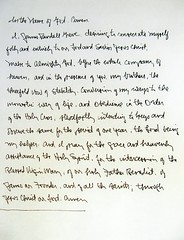
Randy's Monastic Vow in his own hand