Monday, February 25, 2008

RCL - Lent 3 A - 24 Feb 2008

Holy Cross Monastery, West Park, NY
Br. Joseph Brown, n/OHC
RCL - Lent 3 A - Sunday 24 February 2008

Exodus 17:1-7
Romans 5:1-11
John 4:5-42


From the wilderness of Sin the whole congregation of the Israelites journeyed by stages, as the Lord commanded.” Exodus 17:1

So begins today's readings. Wandering in the wilderness, the people of God want water. A few thousand years later we are still wandering in the wilderness wanting water. Why are we so thirsty? Why is it that we have more than any civilization before us could even have imagined and yet millions die for lack of water. And not only actual water, but even more “Living Water”. Why are we still so thirsty? A gallon of coca cola, a mountain of chocolate, this car, that partner, this much in the bank, this handbag, that celebrity, this degree, that position, why does it not quench the thirst?

Well, maybe if I prayed like "that", or did this course, or practiced this yoga, or went to that church, or lost weight or gained weight, or went to the gym or quit smoking, or meditated more or medicated more, then, then the craving would leave. I would fill this hole in my heart and have a happy, content and successful life. But, when that still does not ease the ache, when I have done everything that I that I thought would fix it, and I still hurt, what is it? What is the problem? I know....it is them. It is their fault. If they would only do what they are supposed to do, if they only believed and know they are supposed to, then it would all be okay. It's them. The Other.

We all have “an other”. The one or ones who we know to be wrong, bad and sinful. It's not hard to find them. All you have to do is to look at the paper or read the news on the Internet. It is the Islamists, the republicans, the democrats, pro-abortion, anti-abortion, liberal Christians and Bishop Jefferts Schori, conservative Christians and Pope Benedict XVI, Serbian, Croats or Kosovars. For some of us, it is our neighbor, our ex-spouse, or even the one in the pew next to you. At this point in this sermon it could even be me. And the litmus test for if they are the other is if that designation is followed by: yes, but they ARE really bad. They really ARE hurtful, exclusive and evil. I know, because they are not like me.

One of the Others for the Israelites was the Samaritans. To Jews, the Samaritans were half-breeds, they had intermarried with the pagans of the Northern Kingdom. They did not worship at the Temple at Jerusalem and used only the Pentateuch as their holy text. And just like today, the hatred was the most intense because they were really of the same family and tribe. We have to keep that idea of the intense hatred in mind when exploring the rest of this text.

Jesus is out in the wilderness. And not in any wilderness, but in Samaria, the land of the Other. We are told that it is noon, so the sun was high and the desert was hot. He stops at the well to get a drink. And in doing so he begins to do the unthinkable: He talks to a woman. A man, especially a rabbi of Jesus' time would never speak directly to a woman unless she was a relative. And this is not just any woman, but one of "them", a Samaritan. The woman is shocked. She also sees him, a Jew, as the other, the enemy. She acknowledges this by saying we have no dealings with each other.

But rather than Jesus engaging in a political or theological discourse, he totally disarms her: "If you knew the gift of God, and who it is that is saying to you, `Give me a drink,' you would have asked him, and he would have given you living water." I am sure her response was said rather mockingly: “Sir, you have no bucket, and the well is deep. Where do you get that living water? Are you greater than our ancestor Jacob, who gave us the well, and with his sons and his flocks drank from it?" This is a jab at the Jewish belief that the Samaritans were not really decedents of Abraham and Jacob. Again, Jesus does not fall for the baiting.

"Everyone who drinks of this water will be thirsty again, but those who drink of the water that I will give them will never be thirsty. The water that I will give will become in them a spring of water gushing up to eternal life." The woman said to him, "Sir, give me this water, so that I may never be thirsty or have to keep coming here to draw water." The woman is asking for magic water. Water that will never have to be drawn again from this well. Water that will magically alleviate her thirst. Before we scoff at her for her magical thinking, how many times have we looked for that magic person, pill, practice or profession that will magically alleviate our thirst or emptiness.

Jesus then keeps her off balance - Call your husband. We have to give the woman great credit for her honesty in answering truthfully. The last thing most of us ever want to do in the presence of the other, the enemy, is to admit our own shortcomings or sins. It is Jesus' response to this honesty that changes the whole dynamic of the conversation. Her admission of her sinfulness and his acknowledgment that he knows all about it, and is still there talking to her, begins a chain reaction. First she saw him as the enemy, then as a man and now she sees him as a prophet, and before it is all over she will see him as Lord.

But right now, she doesn't know what to think. He knows all about her. How could he? Who is this man, this Jew, who has the audaciousness to speak to her and make these cryptic comments? The next line of questions she ask is familiar to any of us who are “professional” religious. When there is the recognition that someone is a religious teacher, minister, priest or even (maybe especially) a monk, the “God questions” start flying. It is an occupational hazard.

And usually the questions begin with a “biggie”: Is Hitler in hell, are all the other religions wrong? Do you worship Mary or a piece of bread?”. For her it is The Question: Jews worshiped in Jerusalem, Samaritans on Mt. Gerizim. Who is right? Jesus answers her question but not as expected. He says that salvation comes from the Jews, and so seems to negate the Samaritan claims, but then he says that the time is coming, and even now is here when “true worshipers will worship the Father in spirit and truth, for the Father seeks such as these to worship him. God is spirit, and those who worship him must worship in spirit and truth.”

I will not even get into what this text might mean other than to say it was just as mysterious for her as it is for us. She acknowledges her confusion by exclaiming “I don't know what to make of what you are saying. But I know that there is one to come, the Messiah and he will explain it all to us.” Then Jesus delivers the most unbelievable, incredible thing that has ever passed by human lips: I AM HE. The woman runs into the city to tell what she has seen and heard. One little line implies that even she was still grappling with the idea that how the One to Come, could be the other: “He couldn't be the Messiah...Could he? A Jew?” Through this dialog between others, through this conversation between perceived enemies, salvation comes to this woman and her people.

And just in case we don't get the point, the disciples who have been away gathering food, return to find Jesus talking with a woman. And not just any woman, but a Samaritan. Good thing they didn't know about the five husbands part. But in contrast to the woman's honesty, they don't say anything. They don't engage in a conversation. They are hungry for the food they have brought. For - you see - conversations are dangerous.

Conversations that are honest and open, that don't try to dismiss differences or cover-up long pent-up feelings, like the one Jesus just had with the woman, have power. Conversations along those lines may result in conversion. Because the truth is that we don't know the truth about the other. Really, we don't want to. To talk to the other and to really listen, requires that we have to drop our defenses. We have to see the other, the person, behind the mask that they have made or that we have made for them. We have to be honest with our own feelings. We have to share our own wounds, we have to be ready to tell them how what they do hurts us, and be ready to hear about how what we do hurts them. I must be ready to question my own assumptions about why they do what they do.

Doing so does not mean that I have to give up my personal beliefs. I do not have to engage in behavior I disagree with and I do not have to agree with those who do. Some people do do bad things, evil things. Love does not mean that I brush those things aside, and do not confront evil. We are in the wilderness and just as Jesus was tempted and fought back against evil, so must we. But let us all remember who we are really fighting against. And that one truly is the other.

Love the Lord your God with all of your heart and all of your mind and all of your soul. And the second commandment is like it: Love your neighbor, the other, as yourself.” That is the living water that Jesus gives. That is what is foreshadowed in the water from the rock in Exodus. It is our selves, our very hearts that are rock and they must be broken for the living water to flow.

This Lent, go into the wilderness, go into Samaria, go to the land of the Other, and talk to them. Take the risk to talk to the Samaritan. Be honest, be loving, treat them with the respect and dignity that you expect for yourself. And you will find the Living Water. You will find the food sent by the Father. You will find that this is the acceptable sacrifice, this is worshiping in spirit and truth, this is the beginning of that Easter joy, the joy that knows no end. Come to the well and drink.

Thursday, February 21, 2008

RCL - Lent 3 A - 24 Feb 2008

St Boniface Episcopal Church, Sarasota, Florida
Br. Bernard Jean Delcourt, OHC
RCL – Lent 3 A - Sunday 24 February 2008


Exodus 17:1-7
Romans 5:1-11
John 4:5-42
Psalm 95

Beloved Lord of All, may the words of my mouth and the meditations of all our hearts help us to live our lives in truth and spirit. May we all contribute to the harvesting of your fields, to the building of your Kingdom. Amen.

As Jesus ran into increasing resistance from religious authorities in Judea, he decided to eschew confrontation and to continue his ministry in Galilee. Now, the shortest route between Judea and Galilee goes through Samaria. Most Jews would have preferred the longer route which would have avoided Samaria altogether.

You see, Jews and Samaritans had a centuries-old, intense dislike for each other. In a nutshell, Jews reproached Samaritans for having lost their Jewish integrity; their religious and ethnic purity. But Jesus deliberately chooses to travel through Samaria.
*****

In his encounter with the woman at the well and the folks of her city of Sychar, Jesus offers us many valuable insights into God's desire to free us up into a life of integrity. Ill point two of them this morning: reconciliation and worship.

First, Jesus brings reconciliation. The Samaritan woman is invited to face herself as she is, there and then. And she is invited to ask for the gift of grace; the well of living water springing up to eternal life. She is invited to step into her own salvation.

And it isn't just anyone that Jesus invites in this way; the gender, the social status and the ethnic origin of who he invites shows that God has little interest for our human boundaries of separation.

The apostles, when they return from their errands into the city, are flabbergasted that Jesus would be speaking with a woman, a Samaritan woman and a compromised Samaritan woman, at that!

But, Jesus shows that God's message is for all; for Jews and non-Jews alike; for people in good standing and for outsiders. God doesn't need to choose the most prestigious and privileged amongst us to work wonders.

The Samaritan woman goes on to become an evangelist in bringing her own people to God.

The disciples too are invited to step out of their own cultural boundaries here. Jesus shows them an enlarged mission; their harvest will extend beyond the Jewish people, starting with those Samaritans they grew up to despise.

*****

Through the events of his meeting with the Samaritan woman at the well, Jesus also teaches us that true worship is not linked to a place, be it the temple in Jerusalem or anywhere else. True worship is the lives we live with God, in truth and spirit. True worship is our lives lived in integrity with God.

You see, worship is that, which we do, that embodies what we value. By showing up in church this morning, for example, you are demonstrating that you give value to the word and the will of God. Our presence here for the liturgy is a common understanding we have of the word "worship."

But everything we are and everything we do can embody what we give value to. When you insist in your relationships on being truthful, respectful and loving, you are worshipping God in God's creatures. When you are re-using, recycling and generally reducing your use of physical resources, you are worshiping God in God's creation, for instance.

All of Life can be worship. Living our lives in truth and spirit is worshiping God in all we are and all we do. We worship God when we live life as if everything we do mattered.

*****

And Jesus, the Christ, the anointed one, tells us where to look to find the sustenance for our life with God. Reconciliation and worship start where we meet the Living God; in our innermost heart, in the quiet of loving presence to all that is.

And there, we are to ask, to receive and to accept the gifts of God: the well of living water that will spring to eternal life and the food of doing God's will.

But asking, receiving and accepting are each important steps of this movement of the heart. Grace is never forced on us. We have to make ourselves available to it (possibly with some help).

The Samaritan woman does not seem to have walked to the well feeling ready and able to accept grace, that day. And yet, in her, little by little, Jesus creates the room for her to receive it.

Jesus starts all of these important teachings, by reaching out to a single person; one person whom, by all conventions, he's supposed to not even speak to. It could be me; it could be you. Salvation starts with your own self. Salvation starts with any one person you interact with in truth and spirit.

*****

So hear what the Samaritan woman's story has to tell us. We are invited not to harden our hearts with self-preoccupations such as reputation; or whether we'll ever have to come to the well to carry water again.

We are invited to listen deeply to the word of God; to listen, as Saint Benedict of Nurcia would put it, with the ear of our heart.

*****

And this reminds me of the reason why I am spending a warm week in Florida in the midst of my bleak New York winter. Ted, your rector, and Bob, your spiritual life team-leader have invited me to come and reflect with you on how to nurture our spiritual lives here at Saint Boniface.

In the coming week, I will be encountering many of you an meeting with clergy, staff and volunteers to explore how to draw more fully on the spring of living water and the will of God, that both reside within our selves.

I look forward to discovering the graces that God has in store for us. And I thank God for your hospitality.

*****
Now, on behalf of all of us, I pray the following Celtic blessing on all our endeavors:
May the eye of God be in dwelling with you,
May the foot of Christ be in guidance with you,
May the shower of the Spirit be pouring on you,
Richly and generously.
Amen.

Monday, February 18, 2008

RCL - Lent 2 A - 17 Feb 2008

Brother James Michael Dowd, n/OHC
RCL - Second Sunday in Lent A – Sunday 17 February 2008

Genesis 12:1-4a
Romans 4:1-5, 13-17
John 3:1-17

The Wind Blows Where It Chooses

For God so loved the world that he gave his only Son, so that everyone who believes in him may not perish but may have eternal life. - John 3:16

In the name of the Living God: Father, Son and Holy Spirit.

Martin Luther described a verse of the Gospel we heard today, John 3:16, as “the heart of the Gospel, the Gospel in miniature.” The Rainbow Man seemed to think that this same verse would get him on t.v. I guess they were both right. After all, if it’s on t.v. - it must be right. You remember the Rainbow man, right? He was the guy that began the craze of holding up a sign at various sporting events that read “John 3:16,” while wearing a rainbow colored wig. There are conflicting reports as to why he did this - some believe that he was only seeking attention - he has had a troubled life; others insist that he was evangelizing.

As a young man I had a great deal of exposure to this chapter of John’s Gospel. You see, for two years I was in the formation program of the Passionists, a Roman Catholic religious order of priests and brothers. The Passionists are particularly dedicated to the preaching of Christ’s Passion and were rather well-known for the mission work they did all over the country, preaching to parishes for week-long missions about the Passion, often using this chapter to illustrate the point. The Passionists wore a habit that was a black cassock with a very large ensignia over their heart shaped like a heart with a flame on top of it which read, in Latin, of course, The Passion of our Lord Jesus Christ. On the belt was a very long rosary and, when preaching, a large crucifix would be placed in the vest or belt which could be easily whipped out at the height of the sermon in order to get people to look upon Jesus “lifted up.” The Passionists had a particular spirituality, almost mystical in nature, that taught that this was the way to be saved: Look upon Jesus lifted up on the cross, just as the people of Israel, wandering in the desert, had to look upon the serpent which Moses lifted up, in order to be saved.

But before we get to our eternal salvation, I’d like for us to focus on Nicodemus for a little bit. As I have been thinking about this passage I have had so many different sermons in mind. It is a reading that gives a preacher any number of topics to talk about. But I have been spending a good deal of time with Nicodemus these past few weeks.

Now I just love Nicodemus. He only appears in John’s Gospel - but he shows up three times. And it is each of those appearances that give us all we know about Nicodemus. The first two verses we heard this morning, really grabbed my attention: “There was a Pharisee named Nicodemus, a leader of the Jews. He came to Jesus by night and said to him, ‘Rabbi, we know that you are a teacher who has come from God;’ In this passage and in chapter 7, where he next appears, Nicodemus is a reasonable, nice guy. A kind of via media type. He sees that Jesus is a good man and refers to Jesus’ miracles saying “no one can do these signs that you do apart from the presence of God.” But when Jesus tells him that he must be “born from above,” Nicodemus reaction is confusion and, I imagine, a kind of “look, this is crazy - what is this guy talking about - good grief, I hope I haven’t backed a nut here.”

You see, Nicodemus was, to quote John, a “leader of the Jews.” He was a Pharisee who could appreciate the fact that Jesus was doing some good work with the folks out there. That Jesus was clearly prayerful and an all-around decent guy. If Yiddish had been invented by this point in history, Nicodemus might have said that Jesus was “a man among men.” But, Nicodemus certainly did not want any boats rocked, or to be challenged on theology, or to have, perhaps worst of all, his personal spirituality threatened. So he came to Jesus “by night,” - under the cover of darkness, to learn more, but not to be noticed or pointed out. In Christian mystical literature, of which John’s Gospel is the earliest example, the imagery of night if often used to represent questioning, confusion, danger and despair. And all of that seems readily evident in Nicodemus approach to Jesus, his questions and, ultimately, his silence.
Nicodemus is in the thick of confusion. He senses something good - maybe even great. But he is stuck with theological and practical constructs that simply do not allow for what Jesus is saying. His heart is telling him yes, but his mind is saying, yelling, no. He is lost in his own nighttime - a nighttime of questioning his own feelings, doubting what he is witnessing to be true, and telling himself not to hope, not to trust, not to love. At least, that is what his questions sound like to me: He is telling himself not to believe in this Jesus because his experience in the world of his day, a world of repressive religious doctrine and oppresive occupation by a foreign power, has taught him only about the night. When you live in the nighttime, you do not live in hope, you do not live in faith, you do not live in love.

I think Jesus must have sensed this about Nicodemus. For his response is filled with a mystical kind of love: “Do not be astonished that I said to you, ‘You must be born from above.’ The wind blows where it chooses, and you hear the sound of it, but you do not know where it comes from or where it goes.” He must have been standing there thinking to himself: What does that mean? The wind blows where it chooses! St. John’s Gospel was written in Greek. Now, the Greek word for wind is pneuma which also means breath and spirit. Did Nicodemus catch this? Did he feel the Spirit blowing into him to give him the breath of life? We will never know, but I suspect something started in that nighttime of questioning and confusion, because Nicodemus is going to make his final appearance in the Gospel in a rather dramatic way.

But that night, in that darkness, Nicodemus remains silent. Unable to articulate what he is thinking or feeling. Unable to make a total commitment to Jesus. Unable to let himself dive head first into the abyss of love. He stands there listening to Jesus say that the Son of Man must be lifted up so that whoever believes in him may have eternal life.

I imagine Nicodemus heading home in a state of utter confusion. Trying to think it through and not quite getting it - not that night. But he must have prayed - and prayed a lot. He must have placed himself in God’s loving hands and asked for guidance. I believe he must have done this because, toward the end of John’s Gospel in chapter 19 , we read that Nicodemus has found his way to Golgotha, where, in broad daylight he will stand by Jesus as he is crucified. He will help Joseph of Arimethea take Jesus’ body down from the cross, anoint his body with myrrh and aloes, and he will help to bury Jesus. In short, he will tend to the crucified Christ. And all in broad daylight. He will do this in front of the gathered crowds, in front of the Pharisees, in front of the Roman army. I can just imagine it all coming together for Nicodemus in those long hours in which he stood at the foot of the cross.
Now, to this day, my personal piety leads me to look up at the Son of Man on the cross the way the Passionists taught me. And somehow, that form of prayer helps me to focus on how much God loves me and all his creation. And if that works for you - go for it. But if it doesn’t work for you, that’s fine too. For in either case, all we have to do is to look around us to see the Son of Man lifted up, not on a crucifix, but in our suffering neighbor.


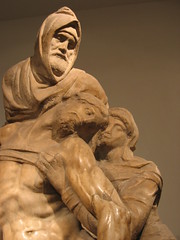
Michelangelo's Florence Pieta
Nicodemus' face is thought to be a self-portrait of the aging artist
Museo dell'Opera, Florence - Originally uploaded by Branchini


This Lent, allow me to commend to you the example of Nicodemus. While we don’t know the details, he must have prayed, and prayed, and prayed some more. Because when that wind guided him up the hill to Golgotha, he only had to look upon the Son of Man lifted up to know that he was saved. So I encourage you, no matter how dark your particular night might be, no matter your questions, confusion, even despair. No matter how dark the night seems, pray, like Nicodemus and then pray some more. Then choose the light of day and look upon the Son of Man lifted up in the lives of the suffering, the poor, the sick, the lonely, the mourning, the victims of war. Let the wind guide you to that Golgotha known as a veterans hospital and tend to Christ crucified in the form of a wounded soldier. Let the wind guide you to that Golgotha known as a homeless shelter and tend to Christ crucified in the form of a hungry mother and child. Let the wind guide you to that Golgotha known as an elderly neighbors’ house and tend to Christ crucified in the form of a widow mourning her losses. Let the wind guide you to that Golgotha known as a prison and tend to Christ crucified in the form of a convict. Look to these sons of men and see Christ crucified. Look to them and stand by them, tend to them, like Nicodemus, and believe that God sent his Son into the world not to condemn it, but in order that the world might be saved through him.

Amen.