Monday, February 18, 2008

RCL - Lent 2 A - 17 Feb 2008

Brother James Michael Dowd, n/OHC
RCL - Second Sunday in Lent A – Sunday 17 February 2008

Genesis 12:1-4a
Romans 4:1-5, 13-17
John 3:1-17

The Wind Blows Where It Chooses

For God so loved the world that he gave his only Son, so that everyone who believes in him may not perish but may have eternal life. - John 3:16

In the name of the Living God: Father, Son and Holy Spirit.

Martin Luther described a verse of the Gospel we heard today, John 3:16, as “the heart of the Gospel, the Gospel in miniature.” The Rainbow Man seemed to think that this same verse would get him on t.v. I guess they were both right. After all, if it’s on t.v. - it must be right. You remember the Rainbow man, right? He was the guy that began the craze of holding up a sign at various sporting events that read “John 3:16,” while wearing a rainbow colored wig. There are conflicting reports as to why he did this - some believe that he was only seeking attention - he has had a troubled life; others insist that he was evangelizing.

As a young man I had a great deal of exposure to this chapter of John’s Gospel. You see, for two years I was in the formation program of the Passionists, a Roman Catholic religious order of priests and brothers. The Passionists are particularly dedicated to the preaching of Christ’s Passion and were rather well-known for the mission work they did all over the country, preaching to parishes for week-long missions about the Passion, often using this chapter to illustrate the point. The Passionists wore a habit that was a black cassock with a very large ensignia over their heart shaped like a heart with a flame on top of it which read, in Latin, of course, The Passion of our Lord Jesus Christ. On the belt was a very long rosary and, when preaching, a large crucifix would be placed in the vest or belt which could be easily whipped out at the height of the sermon in order to get people to look upon Jesus “lifted up.” The Passionists had a particular spirituality, almost mystical in nature, that taught that this was the way to be saved: Look upon Jesus lifted up on the cross, just as the people of Israel, wandering in the desert, had to look upon the serpent which Moses lifted up, in order to be saved.

But before we get to our eternal salvation, I’d like for us to focus on Nicodemus for a little bit. As I have been thinking about this passage I have had so many different sermons in mind. It is a reading that gives a preacher any number of topics to talk about. But I have been spending a good deal of time with Nicodemus these past few weeks.

Now I just love Nicodemus. He only appears in John’s Gospel - but he shows up three times. And it is each of those appearances that give us all we know about Nicodemus. The first two verses we heard this morning, really grabbed my attention: “There was a Pharisee named Nicodemus, a leader of the Jews. He came to Jesus by night and said to him, ‘Rabbi, we know that you are a teacher who has come from God;’ In this passage and in chapter 7, where he next appears, Nicodemus is a reasonable, nice guy. A kind of via media type. He sees that Jesus is a good man and refers to Jesus’ miracles saying “no one can do these signs that you do apart from the presence of God.” But when Jesus tells him that he must be “born from above,” Nicodemus reaction is confusion and, I imagine, a kind of “look, this is crazy - what is this guy talking about - good grief, I hope I haven’t backed a nut here.”

You see, Nicodemus was, to quote John, a “leader of the Jews.” He was a Pharisee who could appreciate the fact that Jesus was doing some good work with the folks out there. That Jesus was clearly prayerful and an all-around decent guy. If Yiddish had been invented by this point in history, Nicodemus might have said that Jesus was “a man among men.” But, Nicodemus certainly did not want any boats rocked, or to be challenged on theology, or to have, perhaps worst of all, his personal spirituality threatened. So he came to Jesus “by night,” - under the cover of darkness, to learn more, but not to be noticed or pointed out. In Christian mystical literature, of which John’s Gospel is the earliest example, the imagery of night if often used to represent questioning, confusion, danger and despair. And all of that seems readily evident in Nicodemus approach to Jesus, his questions and, ultimately, his silence.
Nicodemus is in the thick of confusion. He senses something good - maybe even great. But he is stuck with theological and practical constructs that simply do not allow for what Jesus is saying. His heart is telling him yes, but his mind is saying, yelling, no. He is lost in his own nighttime - a nighttime of questioning his own feelings, doubting what he is witnessing to be true, and telling himself not to hope, not to trust, not to love. At least, that is what his questions sound like to me: He is telling himself not to believe in this Jesus because his experience in the world of his day, a world of repressive religious doctrine and oppresive occupation by a foreign power, has taught him only about the night. When you live in the nighttime, you do not live in hope, you do not live in faith, you do not live in love.

I think Jesus must have sensed this about Nicodemus. For his response is filled with a mystical kind of love: “Do not be astonished that I said to you, ‘You must be born from above.’ The wind blows where it chooses, and you hear the sound of it, but you do not know where it comes from or where it goes.” He must have been standing there thinking to himself: What does that mean? The wind blows where it chooses! St. John’s Gospel was written in Greek. Now, the Greek word for wind is pneuma which also means breath and spirit. Did Nicodemus catch this? Did he feel the Spirit blowing into him to give him the breath of life? We will never know, but I suspect something started in that nighttime of questioning and confusion, because Nicodemus is going to make his final appearance in the Gospel in a rather dramatic way.

But that night, in that darkness, Nicodemus remains silent. Unable to articulate what he is thinking or feeling. Unable to make a total commitment to Jesus. Unable to let himself dive head first into the abyss of love. He stands there listening to Jesus say that the Son of Man must be lifted up so that whoever believes in him may have eternal life.

I imagine Nicodemus heading home in a state of utter confusion. Trying to think it through and not quite getting it - not that night. But he must have prayed - and prayed a lot. He must have placed himself in God’s loving hands and asked for guidance. I believe he must have done this because, toward the end of John’s Gospel in chapter 19 , we read that Nicodemus has found his way to Golgotha, where, in broad daylight he will stand by Jesus as he is crucified. He will help Joseph of Arimethea take Jesus’ body down from the cross, anoint his body with myrrh and aloes, and he will help to bury Jesus. In short, he will tend to the crucified Christ. And all in broad daylight. He will do this in front of the gathered crowds, in front of the Pharisees, in front of the Roman army. I can just imagine it all coming together for Nicodemus in those long hours in which he stood at the foot of the cross.
Now, to this day, my personal piety leads me to look up at the Son of Man on the cross the way the Passionists taught me. And somehow, that form of prayer helps me to focus on how much God loves me and all his creation. And if that works for you - go for it. But if it doesn’t work for you, that’s fine too. For in either case, all we have to do is to look around us to see the Son of Man lifted up, not on a crucifix, but in our suffering neighbor.
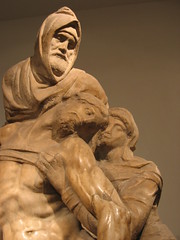

Michelangelo's Florence Pieta
Nicodemus' face is thought to be a self-portrait of the aging artist
Museo dell'Opera, Florence - Originally uploaded by Branchini


This Lent, allow me to commend to you the example of Nicodemus. While we don’t know the details, he must have prayed, and prayed, and prayed some more. Because when that wind guided him up the hill to Golgotha, he only had to look upon the Son of Man lifted up to know that he was saved. So I encourage you, no matter how dark your particular night might be, no matter your questions, confusion, even despair. No matter how dark the night seems, pray, like Nicodemus and then pray some more. Then choose the light of day and look upon the Son of Man lifted up in the lives of the suffering, the poor, the sick, the lonely, the mourning, the victims of war. Let the wind guide you to that Golgotha known as a veterans hospital and tend to Christ crucified in the form of a wounded soldier. Let the wind guide you to that Golgotha known as a homeless shelter and tend to Christ crucified in the form of a hungry mother and child. Let the wind guide you to that Golgotha known as an elderly neighbors’ house and tend to Christ crucified in the form of a widow mourning her losses. Let the wind guide you to that Golgotha known as a prison and tend to Christ crucified in the form of a convict. Look to these sons of men and see Christ crucified. Look to them and stand by them, tend to them, like Nicodemus, and believe that God sent his Son into the world not to condemn it, but in order that the world might be saved through him.

Amen.

Sunday, February 10, 2008

RCL - Lent 1 A - 10 Feb 2008

Holy Cross Monastery, West Park, NY
Fr. Anthony Cayless, AHC
RCL - Lent 1 A - Sunday 10 February 2008

Genesis 2:15-17; 3:1-7
Romans 5:12-19
Matthew 4:1-11

On Mondays and Thursdays in Lent the Antiphon on the Psalter at Matins in our Monastic Breviary is: "Examine yourselves: are you living the life of faith? Put yourselves to the test."

In the 1960's, there was renewed interest in worship in all the churches. At Vatican II the Roman Catholic Church decided that Latin Liturgies should be in the language of the people. Roman Catholic, Anglican, Presbyterian, Methodist, and Lutheran scholars came together to assist those working on new worship books. They formed (ICET) an International Commission on English Texts. This group produced translations from the original Hebrew, Greek, and Latin of Psalms, Canticles, Gloria, Creeds, the Collects, Eucharistic Prayers, and the Lord's Prayer.

Their first translation of the phrase in the Lord's Prayer "Lead us not into temptation" was "Do not bring us to the test" and this was incorporated in the proposed Alternative Service Book of the Church of England, the trial liturgies of the Episcopal Church, and the proposed Liturgy of the Church in the Province of the West Indies, where I was then serving.

Now "test" has a peculiar connotation in the West Indies. As part of the British Commonwealth cricket was our major sport; almost our religion. The Barbados cricket team captained by Gary Sobers could beat any team: England, Australia, India, Pakistan, New Zealand, South Africa. Gary Sobers was also captain of the West Indies, a team not quite as strong as the Barbados team for The West Indies Cricket Board of Control felt it necessary to include players from Trinidad, Guyana, Jamaica, and later the Leeward and Windward Islands.

In 1974 Australia was touring the West Indies. Their first game was against Barbados who beat them easily. They then went to Trinidad and restored some confidence in themselves by forcing a draw. They returned to Barbados to practice for the first Test. The Test Match began at Kensington Oval on Saturday March 9 continuing through Friday March 14. Five days seven hours a day with a break for lunch and tea. Tuesday was a day off.

Play on Sunday was included in the schedule for the first time in 1956 when the English test team was in Barbados. Gordon Hazlewood, Dean of St. Michael's Cathedral, and Ken Towers the Methodist Minister organized opposition to Sunday Cricket. Holding many public meetings and drawing large crowds they announced that they would lay on the pitch before the wicket to prevent the first ball being bowled. The West Indies Cricket Board of Control agreed that Games in the series would not be played on Sundays. Nevertheless by the late sixties Sunday Cricket crept in with the compromise that the day's play would not start before noon so that people could attend Church.

Barbadians are avid Churchgoers. To be in Church is important. Cricket is also important. Schools close, giving their students a cricket holiday so that students and staff can go to the Test. Government Offices and businesses close so that employers and employees can go to the Test. The two radio stations and the single television channel broadcast ball by ball commentaries over the five days of the Test followed by much analysis.

Now it happened that on Sunday, March 17 in 1974 in St. Michael's Cathedral for the first time, we were using the new trial liturgy during this Australian Test Match. There were close on a thousand persons in Church at the 9.00 a.m. Eucharist. I was Presiding and so was in the Celebrant's Stall. Opposite me was Dean Crichlow in his stall. The Bishop resplendent in Cope and Miter was sitting in his Cathedra by the High Altar. Using the proposed liturgy for the first time, we reached the Lord's Prayer: I said: "As our Savior Christ has taught us we now pray". And for the first time we all recited:

Our Father in Heaven,
Hallowed be your Name,
Your Kingdom come,
Your will be done On earth as in heaven.
Give us today our daily bread.
Forgive us our sins
As we forgive those who sin against us.
Then:
"Do not bring us to the test" . . .

Cricket in the Caribbean
Originally uploaded by عleem

At this moment the incongruity struck me! I raised my head and my eyebrows catching the Dean's eye. Do not bring us to the test! The one thing that almost everyone in that Cathedral at that moment wanted was to go to the Test, to be at the Test! They were anxious for the Eucharist to end so that they could get to the Test! Somehow I pulled myself together and kept going.

In 1975 ICET published a second edition of Prayers we have in Common: In this edition the phrase "Do not bring us to the test" was changed to "Save us from the time of trial". We use this in our Monastery Rite. It is also in the 1979 Book of Common Prayer as an alternative in Rite II. So now the line: "Save us from the time of trial" cannot confuse West Indians and is indeed a possible translation. The Church of England used this for a time but have since in gone back to "Lead us not into temptation."

The Greek noun translated time of trial or test or temptation is πειρασμός it derives from the verb πειράζω to try, to test, to learn the genuineness of something by examination and testing. It is used in today's Gospel account of the temptation of Jesus.

For Jesus the wilderness experience at the beginning of his ministry is πειρασμός a testing, a trial, a temptation. The human Jesus has become aware of who he is and is catching a glimpse of his task, the message he is to proclaim, the mission he is to fulfill, the road he is to travel. As it unfolds he is to become a living demonstration of the power of love in action. God's love.

The three temptations Jesus endured in the wilderness, and the many temptations which continue throughout his ministry: the temptation not to take the Jerusalem Road, the temptation in the Garden of Gethsemane to turn aside and not to face the Cross, the temptation to come down from the cross, are all temptations to disobedience - for the human Jesus to be less than what he is, to fall short of his own glory, to fail to carry out his own destiny, To fail to be fully human and truly divine.

Temptation is not sin. Jesus was tempted. As the writer of the Epistle to the Hebrews puts it "in Jesus we do not have a high priest who is unable to sympathize with our weaknesses, but we have one who in every respect has been tested as we are, yet without sin."

We do not have to worry about being tempted. We should start worrying if we are not. That could mean that we have become complacent, self satisfied, self righteous. There were many in the society in which Jesus operated who were like that. He calls them hypocrites, actors. People who are pretending. People who are not themselves. People who are less than God intends them to be, is calling them to be.

The temptations of Jesus' disciples, his followers, including us his followers today, are in essence the same as those which Jesus withstood: temptations to disobedience, to be less than what we are, to fall short of the glory of God. Temptation is part of the human condition. The essential characteristic of temptation is compromise, to be a little less than what God is calling you to be, what God is calling you to do.

We recognize this when we give in to temptation. At least when we are caught. We make excuses. It is not like me. I am really not like that. I was not myself. I was beside myself. I don't know what made me do it - or even "the Devil made me do it."

It is not a bad thing to become aware that we all too often fall short of God's glory providing that we are also aware that God's forgiveness is full and free. God never stops loving us. We can always make a new start. That is what Lent and life is all about.

The final sin is to give up, to stop going along the road God is calling us to travel. Don't give up. Go along with Christ and keep on going.

"Examine yourselves: are you living the life of faith? Put yourselves to the test."

AMEN

Wednesday, February 6, 2008

RCL - Ash Wednesday - 06 Feb 2008

Holy Cross Monastery, West Park, NY
Mrs. Suzette Cayless, AHC
RCL - Ash Wednesday - Wednesday 06 February 2008

Joel 2:1-2;12-17 or Isaiah 58:1-12
2 Corinthians 5:20b-6:10
Matthew 6:1-6,16-21

When I was at school I had a Physics Teacher named Miss Shaw. She did not like the fact that most of us simply tried to memorize formulae in order to solve the many problems she set. Her constant message was “Go back to first principles!” She did not approve of our desire for shortcuts. She wanted us to be able to work out solutions by understanding what was going on and being able to find the answers by really working through the problems. “Go back to first principles!” That, I think is the message of Ash Wednesday.

As Joel puts it: “Yet even now,” says the Lord, “return to me with all your heart, with fasting, with weeping, and with mourning: and rend your hearts and not your garments.” St. Paul urges his friends to “be reconciled to God” and “not to accept the grace of God in vain.” The Gospel today shows up the conflict in our turning to God, warning about simply practicing piety in order to gain recognition from others and not as a sign of truly returning to God.

There is a conflict here for all of us. We like to find the shortcuts; we like pious practices that at least make us feel we are doing something - memorizing the formulae without understanding the first principles. T.S. Eliot displays this conflict in his strange poem “Ash Wednesday” part of which goes like this:
Because I know that time is always time
And place is always and only place
And what is actual is actual only for one time
And only for one place
I rejoice that things are as they are and
I renounce the blessed face
And renounce the voice
Because I cannot hope to turn again
Consequently I rejoice, having to construct something
Upon which to rejoice

And pray to God to have mercy upon us
And pray that I may forget
These matters that with myself I too much discuss
Too much explain
Because I do not hope to turn again
Let these words answer
for what is done, not to be done again
May the judgement not be too heavy upon us.

Our repentance is meant to be real, a going back to first principles, being reconciled to God, hearing the commandments of God “you shall love the Lord your God with all your heart, and with all your soul, and with all your mind, and with all your strength” and “you shall love your neighbor as yourself.” To love God and to love our neighbor is the basis of our faith. As Jesus made clear throughout his ministry, without love we are nothing. Only love can change us and only the acceptance of God’s love can enable us to access and live by the grace offered day by day. Love is the means by which we serve others, by which we delight God, by which alone we can be saved. It is through Love that we become and develop as authentic human beings.

I want to read an extract from “The Velveteen Rabbit” by Margery Williams that illustrates this first principle very nicely:
The Skin Horse had lived longer in the nursery than any of the others. He was so old that his brown coat was bald in patches and showed the seams underneath, and most of the hairs in his tail had been pulled out to string bead necklaces. He was wise, for he had seen a long succession of mechanical toys arrive to boast and swagger, and by-and-by break their mainsprings and pass away, and he knew that they were only toys, and would never turn into anything else. For nursery magic is very strange and wonderful, and only those playthings that are old and wise and experienced like the Skin Horse understand all about it.
“What is real?” asked the Rabbit one day, when they were lying side by side near the nursery fender, before Nana came to tidy the room. “Does it mean having things that buzz inside you and a stick-out handle?”
“Real isn’t how you are made,” said the Skin Horse. “It’s a thing that happens to you. When a child loves you for a long, long time, not just to play with, but really loves you, then you become Real.”
“Does it hurt?” asked the Rabbit.
“Sometimes,” said the Skin Horse, for he was always truthful. “When you are Real you don’t mind being hurt.”
“Does it happen all at once, like being wound up,” he asked, “or bit by bit?”
“It doesn’t happen all at once,” said the Skin Horse. “You become. It takes a long time. That’s why it doesn’t often happen to people who break easily, or have sharp edges, or who have to be carefully handled. Generally, by the time you are Real, most of your hair has been loved off, and your eyes drop out and you get loose in the joints and very shabby. But these things don’t matter at all because once you are Real you can’t be ugly, except to people who don’t understand.”
“I suppose you are Real?” said the Rabbit. And then he wished he had not said it, for he thought the Skin Horse might be sensitive. But the Skin Hose only smiled.
“The Boy’s uncle made me Real,” he said. “That was a great many years ago; but once you are Real you can’t become unreal again. It lasts for always.”

As we receive the imposition of ashes today, as we prepare to practice our Lenten disciplines, let us recall to mind the first principles of our faith. Let us determine that we shall turn to God in heart and mind; that we shall receive God’s Love and love God in return so that we may become Real and truly be what God calls us to be; that we shall recall the Cross at the center of our faith and the arms spread wide to touch and embrace in love all humankind; and ourselves endeavor to love our neighbor for Jesus Christ’s sake.

Amen.